News
To provide superior quality products and competitive price is our insistent pursuit.
Position :
Home > News

Trailer Playground for Sale: Towable Mobile Soft Play for Rental Businesses

2026-11-17

What is a trailer playground?

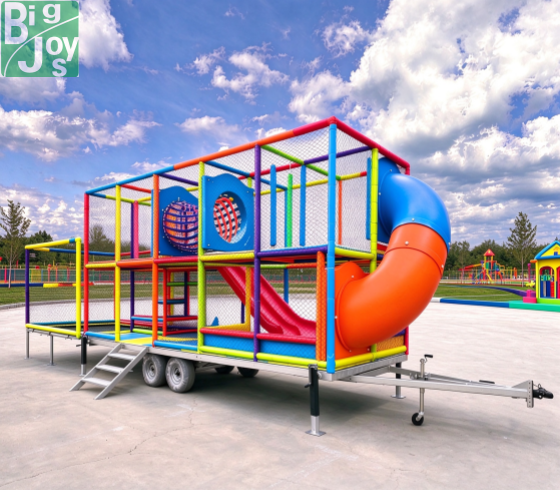
A trailer playground is a complete children's soft play centre built on a road-legal trailer, towed to parties, fairs and festivals instead of staying in one place. Big Joys models start from $8,000, suit ages 2 to 8, and set up in 15–30 minutes with two people. They are EN 13814 certified, with CE and ASTM documentation available.

A playground that goes to the crowd

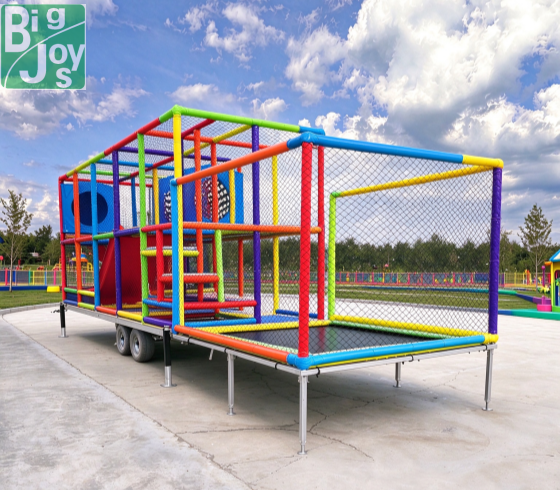
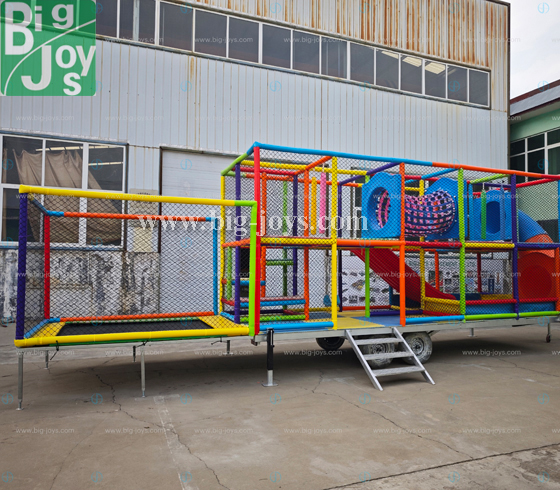
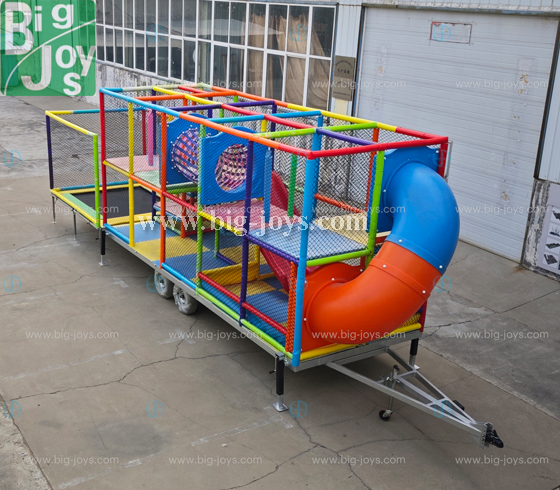
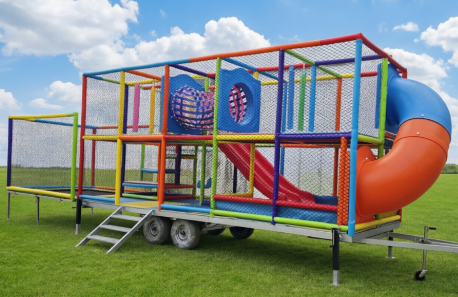
A fixed playground waits for families to come to it. It is bolted into rubber surfacing in one park, one schoolyard or one community space, and it can only serve the people who travel there. A trailer playground reverses that. The whole play centre — multi-level soft play, slides, climbing ramps, obstacle course, ball pit and activity panels — is built onto a heavy-duty trailer chassis, fully enclosed in safety netting, and ready to roll to wherever families already are.
That one difference is why rental operators, event planners and family entertainment businesses buy them. A single unit can work a suburban birthday party on Saturday, a three-day county fair the following week and a holiday park the weekend after. For schools, churches, councils and community groups it delivers a full play facility with no groundworks, no permanent installation and no planning application for a fixed structure. It sets up on short grass, asphalt, concrete lots and paved plazas, as long as the ground is reasonably level.

How it works: tow, unfold, open

The play structure is pre-assembled at the factory and stays mounted on the trailer. Nothing has to be unloaded, sorted and rebuilt at the venue, which is the part of loose portable soft play that eats hours and staff. On site the crew lowers four heavy-duty stabilizer jacks, unfolds the side play panels and lowers the access ramps. The play zone is ready in 15 to 30 minutes with two people.
  • Pre-mounted structure: no disassembly between bookings — the soft play modules travel in place, locked to the frame;
  • Road-legal chassis: hot-dip galvanized steel, with highway running lights, reflective markers, electric brakes and balanced axles for public-road towing;
  • Stabilizer jacks: the jacks remove wobble and sway on slightly uneven grass or pavement once the unit is parked;
  • Padding: high-density EPE foam wrapped in stain-resistant, fire-retardant PU leather, with every edge rounded and covered — no exposed metal corners;
  • Safety netting: high-tensile, UV-stabilized and tear-resistant, so parents and supervisors can see in while children cannot climb out or fall;
  • EVA flooring: thick, non-slip, shock-absorbent matting that keeps its grip when slightly damp and cushions falls;
  • Optional canopy roof: an optional heavy-duty waterproof PVC canopy that blocks UV and light rain, with mesh side panels keeping air moving on hot days.

Specifications

Item Standard layout Notes
Product Trailer playground (mobile soft play trailer) Also called a towable playground trailer or trailer-mounted soft playground
Trailer sizes Compact 16 ft, 20 ft and larger Representative models measure about 8.75 m × 2.5 m; one listed model is 9.05 m × 2.3 m
Age range 2–8 years Standard layout. Larger premium layouts are designed for mixed-age groups
Play elements Slides, climbing ramps and platforms, obstacle course, ball pit, activity panels, balance beams, crawl tunnels Mini-trampoline zones are part of the larger premium version
Setup time 15–30 minutes Two-person crew; unit arrives pre-assembled
Frame / chassis Hot-dip galvanized steel Rust-resistant; play structure bolted to the frame, not strapped
Materials EPE foam padding in PU leather, EVA floor matting, HDPE activity panels, UV-stabilized safety netting, galvanized steel tube and PE Vinyl surfaces wipe clean; individual modules can be replaced separately
Road equipment Running lights, reflective markers, electric brakes, balanced axles, stabilizer jacks Check local width, GVWR, brake and lighting rules before operating
Certification supplied EN 13814 certified; CE certification; ASTM and AS/NZS documentation available See the US compliance section below — EN 13814 / CE alone is not US compliance
Customization Theme wraps, brand colours, logo and QR-code exterior printing, LED accent lighting, storage lockers, childproof-latch gates Themes include safari, unicorn, space, pirate, farm, carnival and seasonal holiday wraps
Price From $8,000 Listed models: Mobile Party Playground $8,000; Portable Playground $9,000; Cartoon Theme $12,000. Ex-works — freight, duty and clearance are extra
Minimum order 1 set
Warranty 12 months On catalogue units


Trailer playground, inflatable or fixed playground?

Most buyers comparing a trailer playground are really choosing between three ways of selling play. The honest differences are setup labour, how the equipment wears, and whether the asset can move to a better-paying venue.
Trailer playground Inflatable bounce house Fixed playground
Setup 15–30 min, 2 people, pre-assembled Blower inflation plus anchoring, staking and safety checks each time Permanent installation with groundworks
Moves between venues Yes — towed on public roads Yes — deflated, rolled and loaded No
Power needed on site None for the play structure itself Continuous blower power while in use None
Main wear risks Worn padding or netting panels, replaced individually Punctures and seam repairs; blower failure stops the attraction Weathering and vandalism in place
Storage Parked folded on a yard or storage lot Needs dry indoor storage space Stays on site
Entry price From $8,000 (Big Joys listed models) Lower for a single unit Highest — equipment plus installation
Best fit Operators who want one durable asset working many venues Operators adding a low-cost attraction to an existing fleet Parks, schools and sites with a permanent location

The practical point for an existing rental fleet is durability per booking. A soft play trailer has no blower running all day and nothing to puncture, and a damaged foam panel or net section can be swapped on its own instead of taking the whole attraction out of service.

Who buys a trailer playground

  • Party and event rental companies — adding a higher-value, lower-maintenance attraction to an existing fleet, and using the printed trailer sides as a moving billboard between jobs.
  • New rental operators — launching a mobile soft play business with one asset that can cover several towns in a week.
  • Family entertainment centres — adding an outdoor or pop-up kids' zone without building one.
  • RV parks, resorts and campgrounds — offering seasonal children's entertainment for weekend and holiday guests.
  • Schools, preschools and churches — for field days, fundraisers and pop-up play days, without a permanent installation.
  • Shopping malls, retailers and employers — as a weekend pop-up that keeps families on site longer, and for corporate family days and open-house events.
End customers rent the same unit for birthday parties, family reunions, county fairs, harvest festivals, food truck rallies, community days, vacation Bible school and holiday markets — which is why demand spreads across the calendar rather than sitting in one season: Easter fairs, summer holidays, Halloween events and Christmas markets all book kids' zones.

Safety and certification — and what US buyers must check

Big Joys trailer playgrounds are designed and certified to EN 13814, the European standard for fairground and amusement park machinery and structures, and are supplied with CE certification. ASTM compliance documentation is available for North American buyers, and AS/NZS test certificates are available for Australia and New Zealand.
US buyers should read that carefully, because EN 13814 and CE do not by themselves make a unit compliant in the United States. Soft-contained play equipment in the US is covered by ASTM F1918, Standard Consumer Safety Performance Specification for Soft Contained Play Equipment, which applies to children aged 2 to 12. Before you buy, ask for the test report for the exact model you are ordering, issued against that standard, and keep it with your insurance file.
  • Amusement device registration and inspection are handled state by state, and requirements differ widely. Some states require registration and an annual inspection; a small number have no state amusement ride programme at all. Check your own state's rules before the unit arrives, not after.
  • Most venues and event organisers will ask for general liability cover — $1 million per occurrence / $2 million aggregate is the level commonly requested — so confirm with your insurer that a trailer-mounted soft play unit is covered under your policy.
  • As the importer, a US buyer is responsible for the children's product certificate and customs filing for imported children's products. Use a customs broker and confirm the tariff classification for your shipment before it leaves the factory.

Inside the unit, the safety details are physical rather than paper-based: rounded, fully padded edges; netting tested to avoid entrapment; handrails sized for small hands; shock-absorbent flooring for fall height; childproof-latched access gates; and a structure bolted to the steel frame rather than held with straps that can work loose.

What it costs, and how the payback works

Listed Big Joys trailer playground models run from $8,000 for the Mobile Party Playground with Trailer, through $9,000 for the Portable Playground, to $12,000 for the Cartoon Theme model, with larger foldable and roofed versions priced above that. Those are equipment prices. They are not the amount a US buyer pays in total.
Budget for the landed cost instead: ex-works price, plus international freight, plus import duty under the tariff classification your broker confirms, plus port, clearance and inland delivery charges, plus any state registration, inspection and insurance costs in your market. Ask for each of those as a separate line on your quotation, with a date on it, so you can compare suppliers on the same basis.
Payback is then a simple division: landed cost divided by your net income per booking. Run it with your own rental rate and your own number of bookings per month, and include towing, cleaning, storage and insurance in the cost side. Be wary of any payback claim that uses a rental rate from another state or another type of equipment — inflatable payback figures in particular are calculated on much cheaper units and do not transfer to a trailer playground.
  • Before you order, check: which model and footprint fits your typical event — compact 16 ft units suit backyard parties and tight venues, 20 ft and larger units suit festivals and high-volume public events;
  • your state's trailer width, GVWR, brake and lighting rules, and its amusement device registration and inspection requirements;
  • the certification documents for the exact model, not the product family;
  • warranty terms, spare parts availability, and whether you receive an operation manual, a safety inspection checklist and operator guidance.

Custom themes turn the trailer into advertising

The layout, colours and exterior can be built around your business. Standard layouts centre on gentle slides, low multi-level platforms, soft balance beams, a ball pit and interactive walls with spinning gears, maze panels and shape-matching games. Larger premium layouts add taller obstacle courses, crawl-through tunnels, multi-lane slides and mini-trampoline zones.
Custom printed theme wraps are the most popular add-on: Christmas winter wonderland, safari jungle, rainbow unicorn, space astronaut, pirate ship, carnival and farm animal artwork are all available, and seasonal panels can be swapped so one trailer works Halloween, Christmas and Easter with a different face. Many operators put their own logo, phone number and social media QR code on the exterior. Because the unit travels on public roads between bookings, it advertises the business everywhere it goes. Other options include built-in storage lockers for cleaning supplies and spares, custom-height entry ramps for wheelchair access, and LED accent lighting for evening markets and after-dark carnival sessions.
Maintenance is deliberately simple. Vinyl and PU leather surfaces wipe clean after each use, netting and foam modules are individually replaceable, and the galvanized frame is built for outdoor use — so a worn section means replacing a panel, not a playground.

Frequently asked questions

How much does a trailer playground cost?

Big Joys listed models start from $8,000 for the Mobile Party Playground with Trailer; the Portable Playground is $9,000 and the Cartoon Theme model is $12,000, with larger foldable and roofed versions above that. Those are ex-works equipment prices, so add freight, import duty and clearance for your landed cost.

What sizes are available?

Compact 16-foot units, 20-foot units and larger models are available. Representative models measure about 8.75 m × 2.5 m, and one listed model is 9.05 m × 2.3 m. Choose by your typical event: 16 ft for backyard parties and tight venues, 20 ft and above for festivals and high-volume public events.

What age group is it for?

The standard layout is designed for children aged 2 to 8, with low platforms, gentle slides and soft balance elements. Larger premium layouts are configured for mixed-age groups, adding taller obstacle courses, tunnels, multi-lane slides and mini-trampoline zones.

How long does setup take, and how many people are needed?

15 to 30 minutes with a two-person crew. The unit arrives pre-assembled on its trailer, so the crew lowers the stabilizer jacks, unfolds the side panels and lowers the access ramps — there is no module-by-module assembly on site.

What certification does it have? Does it meet US requirements?

Units are EN 13814 certified and supplied with CE certification, and ASTM and AS/NZS documentation is available. EN 13814 and CE alone do not equal US compliance: soft-contained play in the US falls under ASTM F1918, so ask for the test report for the exact model you are ordering and check your state's registration and inspection rules.

How much are shipping and import duties to the US?

They depend on the model, the destination port and the tariff classification of your shipment, so they are quoted per order rather than published as a fixed figure. Ask for a dated quotation that separates ex-works price, freight, duty and clearance, and have your customs broker confirm the classification before the unit ships.

Do I need state registration or inspection to operate one?

In many states, yes. Amusement device registration and inspection are set state by state and vary widely, and some states require an annual inspection. Check your state's amusement ride programme and your insurer's requirements before your first booking.

What is the warranty?

12 months on catalogue units. Individual foam, netting and panel modules can be replaced separately after the warranty period, so a worn section does not mean replacing the whole playground.

What is the minimum order quantity?

One set. Single-unit orders suit rental start-ups and operators testing a new market, and themes, colours, layouts and exterior branding can still be customised on a single unit.

Can I customise the theme and put my own branding on it?

Yes. Theme wraps, colours and layouts are customisable, and the exterior can carry your company logo, contact details and social media QR code, which turns the trailer into a moving advertisement between events.

Get a quotation

Tell us your city and state, the model size you are considering and the type of events you plan to run, and we will quote the unit with freight shown separately so you can see your landed cost.
  • Website: https://www.big-joys.com
  • WhatsApp: https://wa.me/8613384016997
  • Email: info@big-joys.com
Zhengzhou BigJoys Amusement Co., Ltd. — manufacturer of amusement rides and playground equipment in Zhengzhou, Henan, China, since 2009. Minimum order one set, 12-month warranty on catalogue units.


Share: